



OPTIMAX: Linear and Mixed Integer Programming Optimization Platform

SHORT SUMMARY
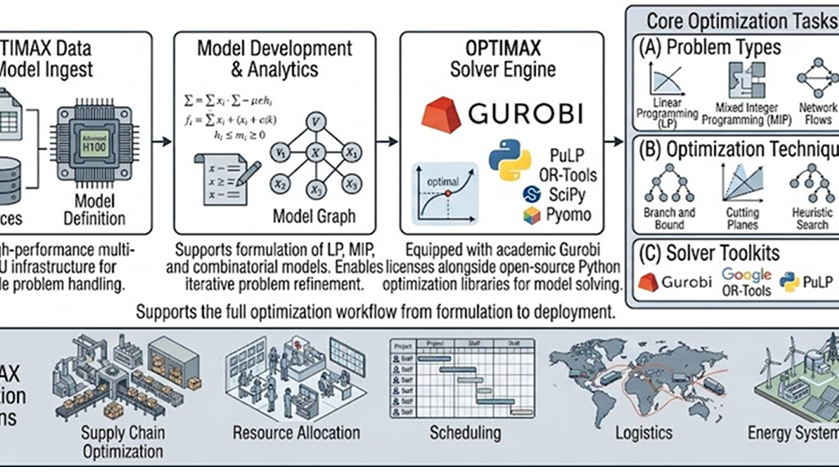
The OPTIMAX Linear and Mixed Integer Programming Optimization Platform provides dedicated computational resources and professional-grade software tools for formulating, solving, and deploying complex mathematical optimization models. Built on high-performance multi-core CPU infrastructure and equipped with academic Gurobi licenses alongside open-source Python optimization libraries (including PuLP, OR-Tools, SciPy, and Pyomo), this testbed enables researchers and industry partners to tackle large-scale linear programming (LP), mixed integer programming (MIP), and combinatorial optimization problems. Application domains include supply chain optimization, resource allocation, scheduling, logistics, and energy systems planning. The environment supports the full optimization workflow, from problem formulation and model development through to solution analysis and deployment-ready implementations. This testbed contributes to the CITADELS Framework by providing accessible, state-of-the-art optimization capabilities relevant to Industry 5.0 challenges such as sustainable production planning, human-centric resource management, and data-driven operational decision-making.

HOSTING INSTITUTION AND PI INFO
| Name of Host Organization | NOVA Information Management School (NOVA IMS), Universidade Nova de Lisboa |
| Department or Lab | MagIC (Information Management Research Center) – the NOVA Information Management School research and development center |
| Name of Building | Manuel Vilares Building |
| Physical Address | Campus de Campolide, 1070-312 Lisboa |
| Website Links | https://www.novaims.unl.pt/ |
| Institutional contact name | Cristina Oliveira |
| Institutional contact email | magic@novaims.unl.pt |

APPLICATION CASES
| Application case: | Short description: |
| Supply Chain Optimization | Formulate and solve large-scale MIP models to optimize inventory levels, distribution routes, and supplier selection across complex supply networks |
| Production Scheduling | Develop LP and MIP models to optimize manufacturing schedules, minimizing costs and maximizing throughput while respecting resource and time constraints |
| Energy Systems Planning | Apply optimization models to support renewable energy integration, grid load balancing, and cost-efficient energy distribution planning |
| Portfolio Optimization | Use linear and quadratic programming techniques to optimize financial asset allocation, balancing risk and return under real-world constraints |

POTENTIAL STAKEHOLDERS
Non-academic stakeholders
Industrial Partners, Startups, Professional Associations, SMEs, Government Bodies, Other (Public agencies and municipalities)
Academic stakeholders
PhD students, MSc students, Researchers, Other (Visiting researchers, Seconded researchers)
Other types of stakeholders
R&I support professionals, R&I infrastructure operators, Innovation intermediaries, Technology transfer actors