



Neuroergonomic Cobot-Assisted Manual Assembly Workstation

SHORT SUMMARY
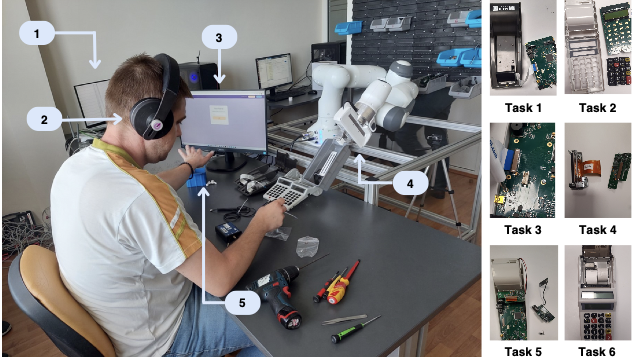
A modular neuroergonomic workstation for human-centered, collaborative manual assembly. The setup combines portable EEG-based mental workload assessment (BrainWatch), a nonintrusive hand-gesture interface (Leap Motion–based M2O2P-L), an adaptive graphical instruction system (ADIN), and a collaborative robot assistant (Franka Emika Panda) that delivers the right parts at the right time. All modules are integrated through FIWARE middleware (Orion Context Broker) and can be extended with a smart task scheduler for workload-aware task allocation. The concept was validated as a proof-of-concept in a real factory environment for assembly of fiscal devices, showing fewer errors and lower mental demand with cobot-supported assembly, while maintaining comparable cycle times. The workstation is designed for easy deployment and reconfiguration across assembly variants, supporting onboarding of new workers and improving well-being and productivity in Industry 5.0 contexts.

HOSTING INSTITUTION AND PI INFO
| Name of Host Organization | University of Belgrade – School of Electrical Engineering (ETF) |
| Department or Lab | Department of Signals and Systems, ETF Robotics Lab |
| Name of Building | Palace of Science |
| Physical Address | Kralja Milana 11, 11000 Beograd, Serbia |
| Website Links | https://robot.etf.bg.ac.rs |
| Institutional contact name | Prof. Dr. Kosta Jovanović |
| Institutional contact email | kostaj@etf.rs |

APPLICATION CASES
| Application case: | Short description: |
| Cobot-supported manual assembly (component delivery) | Franka Panda delivers the correct parts in sequence to reduce searching and handling errors; the worker confirms step completion via gesture. Experiments: compare cycle time, picking errors, and reach distance with/without cobot delivery; evaluate ergonomic load reduction when parts are presented in optimal pose/location. |
| EEG-based workload monitoring and decision support | BrainWatch computes TAR/TBR/EI in real time to estimate mental workload and support workload-aware breaks or task (re)allocation. Experiments: induce low/high cognitive load conditions (e.g., time pressure, interruptions), then quantify workload indices vs. performance (errors, completion time) and evaluate adaptive interventions (micro-breaks, task simplification). |
| Gesture-based human–machine interaction | Leap Motion + VGG16 classifier enables hands-free, nonintrusive commands for progressing/rolling back instruction steps. Experiments: measure recognition accuracy/latency under shop-floor conditions (gloves, occlusions, varying illumination); compare gesture control to buttons/voice for speed and user preference. |
| Adaptive instruction authoring and visualization | ADIN shows step-by-step guidance (parts/tools/safety notes) and supports fast creation/editing of new task sequences without SQL expertise. Experiments: evaluate authoring time and instruction quality across expert vs. novice process engineers; assess learning curves and reduction of instruction inconsistencies across variants. |
| XR-assisted guidance and training via VR headsets | The TestBed extends instruction delivery into XR by presenting step-by-step guidance, alerts, and confirmations through a VR/XR headset (e.g., Meta Quest-class device), enabling hands-free, immersive visualization of assembly sequences and safety cues. Experiments: compare conventional screen-based instructions vs. XR presentation on time-to-competency, error rate, and perceived workload; test seamless transitions between “training mode” (immersive walkthrough) and “production mode” (quick overlays/confirmations). |

POTENTIAL STAKEHOLDERS
Non-academic stakeholders
Industrial Partners, Startups, Professional Associations, SMEs, Other (Factory operators; production managers, HSE/OSH officers)
Academic stakeholders
Undergraduate students, PhD students, MSc students, Researchers, Other (Human factors/ergonomics students, industrial engineering students)
Other types of stakeholders
Ethics committees, data protection officers