




Optimization powered mobile manipulation task planning for agriculture pick and carry tasks

SHORT SUMMARY
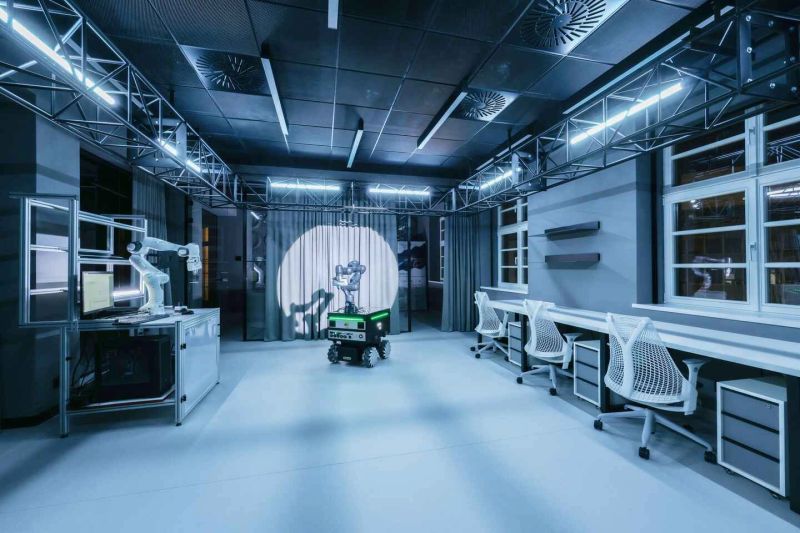
The proposed TestBed offers an integrated platform for validating multi-robot autonomous crop collection in realistic agricultural logistics scenarios. Its core technology focus is the coordination of heterogeneous mobile manipulators through an optimization-based global planner, where the Crop Collection Problem is formulated as a Flexible Multi-Depot Capacitated Vehicle Routing Pickup Problem (FMDCVRP-P). This approach enables robots to dynamically start and end at different depots, reducing unnecessary travel and minimizing overall mission makespan.
The TestBed combines Mixed-Integer Linear Programming (MILP) optimization with a full ROS2–ROS1 simulation and deployment pipeline, including Gazebo-based multi-robot environments, task scheduling, MoveIt-enabled manipulation, and autonomous navigation using AMCL and TEB planners integrated for the RBKAIROS+ Mobile Manipulator.
This TestBed is highly relevant to DeepTech and Industry 5.0, supporting scalable, intelligent, and human-centered automation for next-generation sustainable agriculture and autonomous logistics.

HOSTING INSTITUTION AND PI INFO
| Name of Host Organization | School of Electrical Engineering University of Belgrade |
| Department or Lab | ETF Robotics Lab |
| Name of Building | Palace of Science |
| Physical Address | Kralja Milana 11, 11000, Belgrade, Serbia |
| Website Links | https://robot.etf.bg.ac.rs |
| Institutional contact name | Prof. Dr. Kosta Jovanovic |
| Institutional contact email | kostaj@etf.rs |

APPLICATION CASES
| Application case: | Short description: |
| Application case 1: Multi-Robot Crop Collection Route Optimization (PoC) | Validation of optimization-based task allocation and routing for fleets of mobile manipulators performing post-harvest crop bin pickup and delivery. The TestBed solves the Crop Collection Problem as a Flexible Multi-Depot Capacitated VRP (FMDCVRP-P), minimizing makespan while respecting payload and depot constraints. This supports Proof-of-Concept deployment of autonomous agricultural logistics. |
| Application case 2: Autonomous Navigation and Obstacle Avoidance in Unstructured Environments
|
Testing robust navigation of RB-KAIROS platforms using ROS Navigation Stack (AMCL localization + TEB local planner) in environments with non-uniform obstacles and sparse map features. Supports Industry 5.0 scenarios requiring safe autonomous mobility in dynamic agricultural or industrial spaces. |
| Application case 3: Mobile Manipulation Pick-and-Carry Experiments | Integration of manipulation planning (MoveIt + OMPL) with autonomous base positioning to perform pick-and-carry tasks of crop bins. Robots execute sequential missions: navigate to pickup point, grasp/load bin, and transport to depot. Demonstrated both in simulation and on a real RB-KAIROS + FR3 system. |
| Application case 4: Educational Use in Robotics and Autonomous Systems Courses
|
The platform contributes to teaching and student projects, supporting coursework in robotics middleware (ROS), mobile manipulation, optimization, and Industry 5.0 automation. Students can reproduce full pipelines from planning to execution. |

POTENTIAL STAKEHOLDERS
| Non-academic stakeholders | |
| Industrial Partners | Pilot deployment and validation studies of robotic sorting, handling, and collaborative operation scenarios under real industrial conditions. |
| SMEs | Testing and prototyping of robotic subsystems, perception algorithms, and circular-economy solutions with reduced development cost and risk. |
| Startups | Rapid validation of innovative robotics and AI concepts related to waste sorting, automation, and sustainability, supporting product development and market readiness. |
| Government Bodies | Evaluation of technological solutions supporting waste management strategies |
| Professional Associations | Dissemination of best practices, technical guidelines, and standards related to collaborative robotics and sustainable waste management. |
| Community | Benefiting from improved recycling infrastructure, increased efficiency of waste processing, and reduced landfill waste, contributing to environmental sustainability. |
| Others 1 (comma-separated) | Environmental NGOs, Waste management authorities, Technology transfer offices |
| Academic stakeholders | |
| Undergraduate students | Hands-on training in robotics, computer vision, and automation through laboratory exercises, project-based learning, and introductory research activities. |
| MSc students | Development and validation of advanced algorithms and system components within master theses focused on robotics, AI, and circular economy applications. |
| PhD students | Long-term experimental research on collaborative robotics, perception, control, and human–robot interaction. |
| Researchers | Experimental validation of scientific hypotheses, development of new methods, publication of research results, and participation in national and international research projects. |
| Others 2 (comma-separated) | Visiting researchers, Postdoctoral fellows, Academic collaborators |
| Other types of stakeholders | |
| Others 3 (comma-separated) | European research partners, Standardization bodies, Funding agencies |

LINKS TO MORE INFO
Some link………