



MEDVISION: Medical Imaging Analytics Platform

SHORT SUMMARY
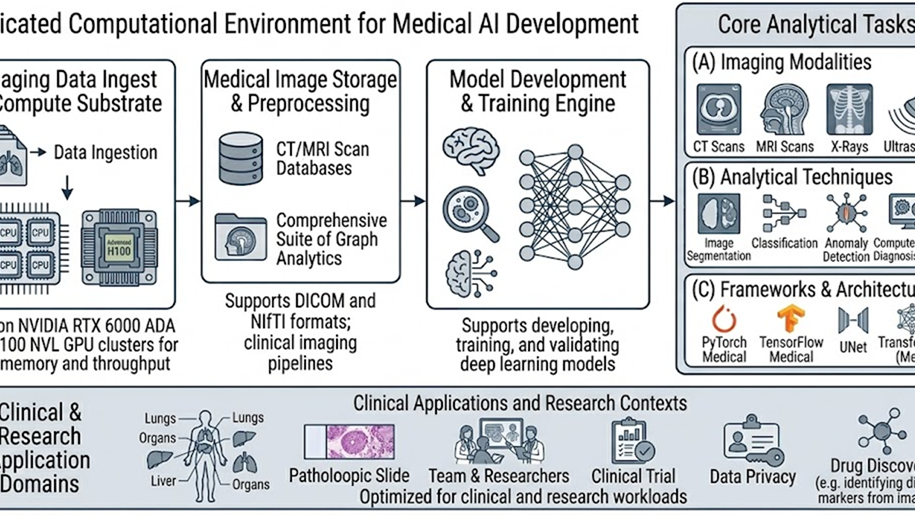
The Medical Imaging Analytics Platform provides a dedicated computational environment for developing, training, and validating deep learning models applied to medical imaging data. Built on NVIDIA RTX 6000 ADA and H100 NVL GPUs, MEDVISION is purpose-configured for the high memory and throughput demands of medical image processing, supporting standard imaging formats and pipelines used in clinical and research contexts. The platform supports a range of imaging modalities and analytical tasks including segmentation, classification, anomaly detection, and computer-aided diagnosis, using frameworks and architectures commonly applied in medical AI research. This testbed contributes to the CITADELS Framework by providing accessible, domain-focused infrastructure that supports the translation of medical imaging AI from research prototype to clinically relevant proof-of-concept.

HOSTING INSTITUTION AND PI INFO
| Name of Host Organization | NOVA Information Management School (NOVA IMS), Universidade Nova de Lisboa |
| Department or Lab | MagIC (Information Management Research Center) – the NOVA Information Management School research and development center |
| Name of Building | Manuel Vilares Building |
| Physical Address | Campus de Campolide, 1070-312 Lisboa |
| Website Links | https://www.novaims.unl.pt/ |
| Institutional contact name | Cristina Oliveira |
| Institutional contact email | magic@novaims.unl.pt |

APPLICATION CASES
| Application case: | Short description: |
| Medical Image Segmentation | Develop and benchmark deep learning segmentation models (e.g., U-Net and its variants) capable of delineating anatomical structures or regions of interest in medical images, supporting downstream diagnostic or treatment planning workflows. |
| Anomaly Detection in Imaging Data | Train convolutional and transformer-based models to identify abnormal patterns in medical imaging data, exploring approaches applicable to screening and triage scenarios where large volumes of images require automated prioritisation. |
| Multi-Modal Imaging Fusion | Experiment with architectures that combine information from multiple imaging modalities or pair imaging data with structured clinical metadata, exploring how complementary data sources can improve diagnostic model performance. |
| Benchmarking and Model Validation for Clinical Translation | Use the testbed to systematically evaluate model performance across diverse imaging datasets and patient subgroups, supporting the rigorous validation workflows required before clinical deployment under EU medical device regulations. |

POTENTIAL STAKEHOLDERS
Non-academic stakeholders
Industrial Partners, Startups, Professional Associations, SMEs, Government Bodies
Academic stakeholders
PhD students, MSc students, Researchers