



Flexible Refrigerator Remanufacturing Cell

SHORT SUMMARY
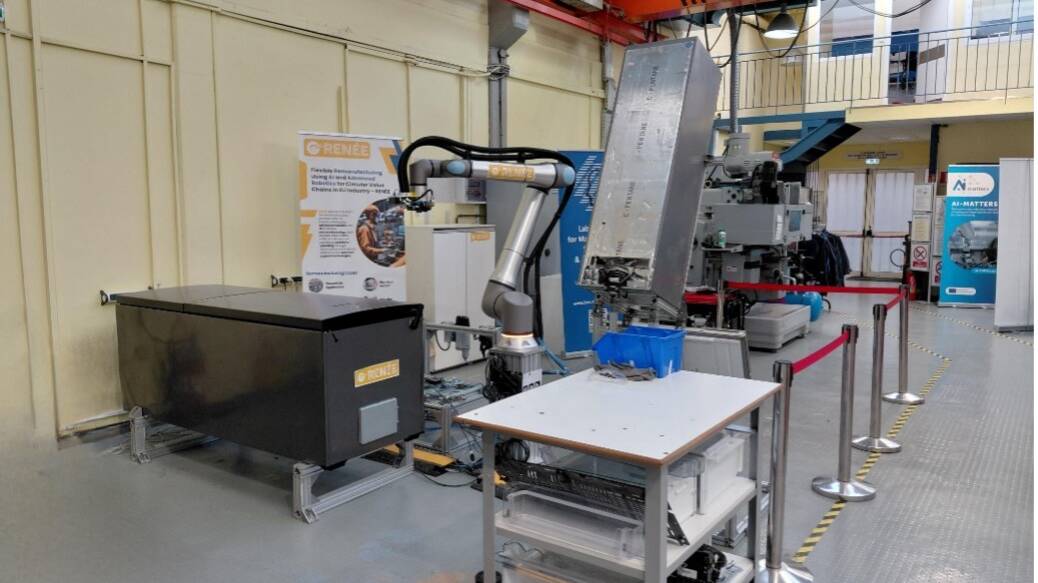
This TestBed focuses on the physical remanufacturing of end-of-life refrigerators through a flexible, human-centric disassembly and component recovery system. It integrates collaborative robotics, adaptive tooling, and modular workstation design to support efficient extraction of high-value components such as compressors, heat exchangers, electronic boards, and structural parts. The TestBed enables controlled disassembly processes under realistic industrial conditions, supporting both manual and semi-automated operations. It is designed to handle variability in product condition, model differences, and wear levels, which are typical in remanufacturing scenarios. By combining robotic assistance with operator supervision, the system enhances safety, ergonomics, and productivity. This infrastructure supports experimentation with remanufacturing workflows, validation of circular economy strategies, and optimization of disassembly sequences. It is particularly relevant for Industry 5.0 applications, emphasizing sustainability, human–machine collaboration, and resource efficiency in appliance lifecycle management.

HOSTING INSTITUTION AND PI INFO
| Name of Host Organization | Laboratory for Manufacturing Systems & Automation (LMS) – Department of Mechanical Engineering & Aeronautics |
| Department or Lab | Main Building of Department of Mechanical Engineering & Aeronautics |
| Name of Building | Campus of University of Patras, Rio, Greece |
| Physical Address | Laboratory for Manufacturing Systems & Automation (LMS) – Department of Mechanical Engineering & Aeronautics |
| Website Links | https://www.upatras.gr |
| Institutional contact name | N/A |
| Institutional contact email |

APPLICATION CASES
| Application case: | Short description: |
| HRC Refrigerator Dissasembly | This application focuses on the HRC disassembly of end-of-life refrigerators using a collaborative robotic system. The robot, equipped with interchangeable tools (screwdriver, gripper, suction), performs repetitive and ergonomically demanding tasks such as unscrewing panels, removing doors, and extracting internal components. The system supports human–robot collaboration, where operators supervise the process and intervene in complex or uncertain situations. This use case enables experimentation with optimized disassembly sequences, reduction of manual effort, and improved safety conditions when handling large and heavy appliances. |
| Human–Robot Collaborative Workflows | This application explores safe and efficient collaboration between human operators and robotic systems in remanufacturing environments. The robot performs repetitive or hazardous tasks, while the operator handles decision-making, quality checks, and complex manipulations. Laser scanners and safety systems ensure safe interaction within shared workspaces. The testbed supports experimentation with ergonomic workstation design, task allocation strategies, and human-in-the-loop control, aligning with Industry 5.0 principles of human-centric production. |
| Flexible Tool Changing and Task Adaptation | This application focuses on the use of automated tool changing systems to enable flexible and adaptive disassembly workflows. The robot dynamically switches between tools (e.g., screwdriving, gripping, suction) depending on the task requirements. This allows the system to handle multiple disassembly steps within a single workflow without manual reconfiguration. The testbed is used to evaluate task planning strategies, tool utilization efficiency, and reduction of downtime, contributing to more flexible and scalable remanufacturing systems. |

POTENTIAL STAKEHOLDERS
Non-academic stakeholders
Industrial Partners, SMEs, Other (Robot manufacturers, system integrators, training/certification providers)
Academic stakeholders
Undergraduate students, PhD students, MSc students, Researchers, Other (Vocational education & training (VET) instructors, continuing professional development (CPD) learners)