



EVOLAB: Genetic and Evolutionary Programming Laboratory

SHORT SUMMARY
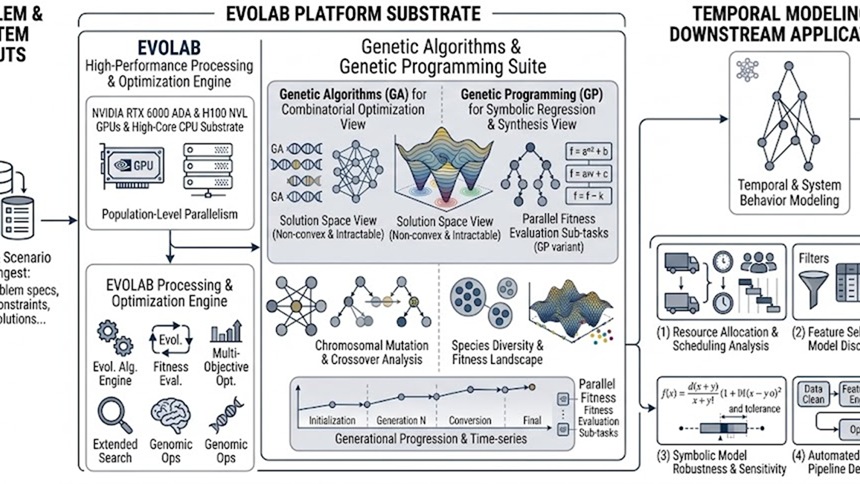
The Genetic and Evolutionary Programming Laboratory provides a dedicated computational environment for developing, executing, and analysing evolutionary computation methods, with a primary focus on genetic algorithms for combinatorial optimisation and genetic programming for symbolic regression and automatic program synthesis. Built on NVIDIA RTX 6000 ADA and H100 NVL GPUs combined with high-core-count CPU infrastructure, EVOLAB is configured to support the population-level parallelism inherent in evolutionary methods, enabling large-scale fitness evaluations, multi-objective optimisation runs, and extended generational searches across complex solution spaces. EVOLAB is specifically oriented toward problems where solution spaces are non-convex, discontinuous, or analytically intractable, and where evolutionary search provides a principled alternative to gradient-based or exact methods. The platform supports research and applied use cases spanning resource allocation, scheduling, feature selection, symbolic model discovery, and the automated design of analytical pipelines. This testbed contributes to the CITADELS Framework by providing accessible infrastructure for evolutionary computation research at a scale and reproducibility that supports both academic investigation and industry-facing proof-of-concept development.

HOSTING INSTITUTION AND PI INFO
| Name of Host Organization | NOVA Information Management School (NOVA IMS), Universidade Nova de Lisboa |
| Department or Lab | MagIC (Information Management Research Center) – the NOVA Information Management School research and development center |
| Name of Building | Manuel Vilares Building |
| Physical Address | Campus de Campolide, 1070-312 Lisboa |
| Website Links | https://www.novaims.unl.pt/ |
| Institutional contact name | Cristina Oliveira |
| Institutional contact email | magic@novaims.unl.pt |

APPLICATION CASES
| Application case: | Short description: |
| Combinatorial Optimisation with Genetic Algorithms | Apply genetic algorithms to hard combinatorial problems such as vehicle routing, job shop scheduling, portfolio optimisation, and resource allocation, benchmarking evolutionary approaches against exact and heuristic methods across problem instances of varying scale and complexity. |
| Symbolic Regression and Interpretable Model Discovery | Use genetic programming to automatically discover mathematical expressions that describe relationships in observed data, providing interpretable, equation-based models as an alternative to black-box machine learning approaches in domains where model transparency is required. |
| Evolutionary Algorithm Benchmarking and Reproducibility | Use the testbed to conduct systematic benchmarking of evolutionary algorithm variants across standard and domain-specific problem sets, supporting rigorous comparative studies and contributing to reproducible evolutionary computation research in line with community standards. |
| MSc and PhD Research in Evolutionary Computation | The platform supports graduate students conducting dissertation and research projects in evolutionary computation, metaheuristics, and automated machine learning, providing the parallel compute capacity required to run population-based searches at scales meaningful for academic publication. |

POTENTIAL STAKEHOLDERS
Non-academic stakeholders
Industrial Partners, Startups, Professional Associations, SMEs, Government Bodies
Academic stakeholders
PhD students, MSc students, Researchers