



DEEPLAB: Deep Learning Research Infrastructure
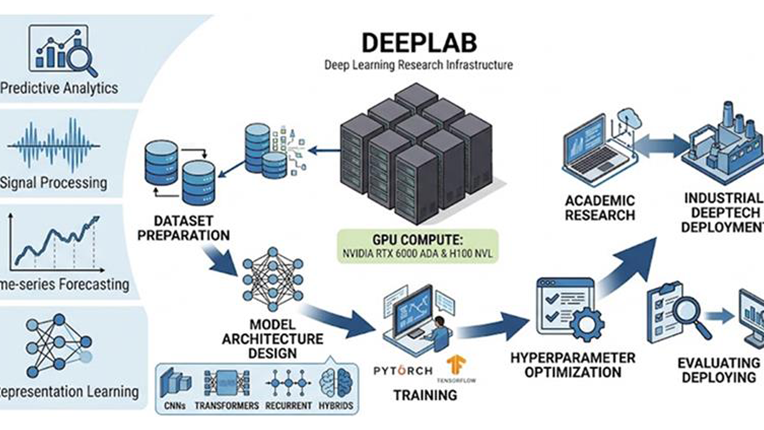

SHORT SUMMARY
The Deep Learning Research Infrastructure provides a versatile, high-performance computing environment for designing, training, evaluating, and deploying deep learning models across a broad range of architectures, including convolutional neural networks (CNNs), transformer-based models, recurrent networks, and hybrid approaches. Built on a combination of NVIDIA RTX 6000 ADA and H100 NVL GPUs, the testbed offers researchers and industry partners scalable GPU compute suited to experiments ranging from lightweight prototyping to large-scale model training. DEEPLAB supports the full deep learning research lifecycle, from dataset preparation and model architecture design through training, hyperparameter optimization, and performance benchmarking. The environment accommodates frameworks such as PyTorch and TensorFlow, and is well-suited to applications across domains including predictive analytics, signal processing, time-series forecasting, and representation learning. This testbed contributes to the CITADELS Framework by providing accessible, institution-grade deep learning infrastructure that bridges the gap between academic research and industrial-scale DeepTech deployment.

HOSTING INSTITUTION AND PI INFO
| Name of Host Organization | NOVA Information Management School (NOVA IMS), Universidade Nova de Lisboa |
| Department or Lab | MagIC (Information Management Research Center) – the NOVA Information Management School research and development center |
| Name of Building | Manuel Vilares Building |
| Physical Address | Campus de Campolide, 1070-312 Lisboa |
| Website Links | https://www.novaims.unl.pt/ |
| Institutional contact name | Cristina Oliveira |
| Institutional contact email | magic@novaims.unl.pt |

APPLICATION CASES
| Application case: | Short description: |
| Time-Series Forecasting with Deep Learning | Train CNN and LSTM-based models on multivariate time-series data for demand forecasting, anomaly detection, and predictive maintenance in industrial and logistics settings. |
| Transfer Learning for Domain-Specific Classification | Fine-tune pre-trained CNN architectures (e.g., ResNet, EfficientNet) on custom labelled datasets for document classification, product categorisation, or sensor-based fault detection. |
| Transformer-Based Tabular and Sequential Data Modelling | Develop and benchmark transformer architectures adapted for structured tabular data and sequential business data, exploring attention mechanisms beyond NLP tasks. |
| Student Deep Learning Research Projects | The testbed supports MSc and PhD students in conducting deep learning experiments as part of dissertations and research projects, providing GPU compute that would otherwise be inaccessible, accelerating the research cycle from hypothesis to published result. |

POTENTIAL STAKEHOLDERS
Non-academic stakeholders
Industrial Partners, Startups, Professional Associations, SMEs, Government Bodies
Academic stakeholders
Undergraduate students, PhD students, MSc students, Researchers