



LLM-based Decision Support

SHORT SUMMARY
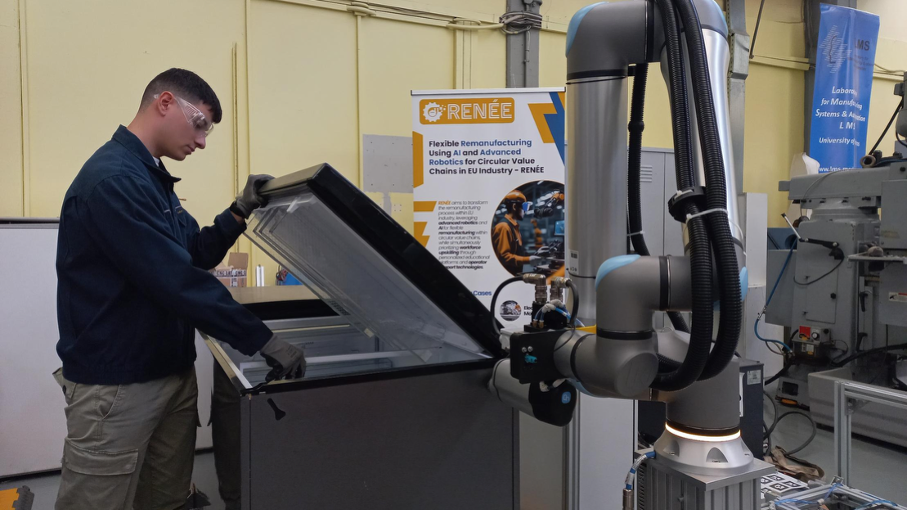
This TestBed focuses on the integration of Large Language Models (LLMs) to support human-centric decision-making in refrigerator remanufacturing processes. It provides an intelligent interface for operators and engineers, enabling real-time guidance, process documentation, and knowledge retrieval across the remanufacturing workflow. The system leverages structured and unstructured data sources, including technical manuals, inspection results, and digital product records, to assist in tasks such as disassembly planning, component evaluation, and process optimization. By translating complex operational data into natural language insights, the TestBed enhances usability and reduces the cognitive load on operators. It also supports training and upskilling through interactive assistance and contextual recommendations. The TestBed aligns with Industry 5.0 principles by placing humans at the center of AI-supported workflows, improving transparency, traceability, and decision quality in circular manufacturing environments.

HOSTING INSTITUTION AND PI INFO
| Name of Host Organization | Laboratory for Manufacturing Systems & Automation (LMS) – Department of Mechanical Engineering & Aeronautics |
| Department or Lab | Main Building of Department of Mechanical Engineering & Aeronautics |
| Name of Building | Campus of University of Patras, Rio, Greece |
| Physical Address | Laboratory for Manufacturing Systems & Automation (LMS) – Department of Mechanical Engineering & Aeronautics |
| Website Links | https://www.upatras.gr |
| Institutional contact name | N/A |
| Institutional contact email |

APPLICATION CASES
| Application case: | Short description: |
| Operator Guidance and Interactive Disassembly Support | This application enables real-time, LLM-based guidance for operators performing refrigerator disassembly and remanufacturing tasks. Through a chat-based or graphical interface, operators can request step-by-step instructions, clarification of procedures, or safety recommendations. The system dynamically adapts responses based on the current task, component type, and workflow stage. It reduces reliance on static manuals and enhances operator efficiency, especially for complex or rarely performed operations. This use case supports training, reduces errors, and ensures consistent execution of disassembly procedures in human–robot collaborative environments. |
| Decision Support for Component Reuse and Remanufacturing | This application focuses on assisting operators and engineers in deciding whether extracted components should be reused, repaired, or discarded. The LLM processes inspection results, historical data, and technical documentation to provide recommendations on component condition and expected usability. It can explain reasoning in natural language, improving transparency and trust. This supports circular economy objectives by optimizing component recovery and reducing waste, while also standardizing decision-making processes across operators. |
| Knowledge Retrieval and Technical Documentation Access | This application enables fast and intuitive access to technical knowledge related to refrigerator components, disassembly procedures, and maintenance guidelines. The LLM acts as an intelligent interface over structured and unstructured data sources, including manuals, process documentation, and operational data. Users can query the system in natural language and receive context-aware answers, reducing time spent searching through documentation. This improves productivity and supports knowledge transfer within remanufacturing facilities. |

POTENTIAL STAKEHOLDERS
Non-academic stakeholders
Industrial Partners, Startups, SMEs
Academic stakeholders
Undergraduate students, PhD students, MSc students, Researchers