



AI-Driven Task Planning and Workflow Optimization for Refrigerator Remanufacturing

SHORT SUMMARY
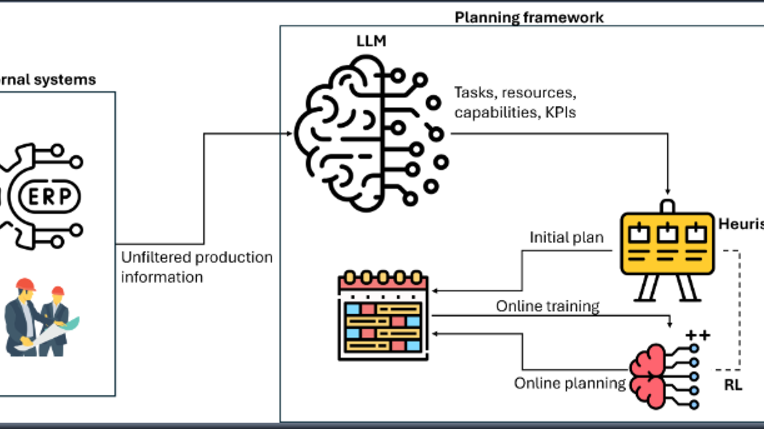
This TestBed focuses on the planning and optimization of remanufacturing workflows for end-of-life refrigerators. It enables the generation, evaluation, and adaptation of disassembly sequences, task allocation strategies, and resource utilization plans in flexible manufacturing environments. The system integrates data from inspection, product specifications, and process constraints to dynamically generate optimal workflows for component extraction and recovery. It supports both offline simulation and real-time adaptation, allowing operators and engineers to evaluate alternative strategies and improve efficiency. The TestBed is designed to handle variability in product condition and configuration, enabling robust planning under uncertainty. It contributes to Industry 5.0 by supporting human-in-the-loop decision-making and improving the sustainability and efficiency of remanufacturing operations.

HOSTING INSTITUTION AND PI INFO
| Name of Host Organization | Laboratory for Manufacturing Systems & Automation (LMS) – Department of Mechanical Engineering & Aeronautics |
| Department or Lab | Main Building of Department of Mechanical Engineering & Aeronautics |
| Name of Building | Campus of University of Patras, Rio, Greece |
| Physical Address | Laboratory for Manufacturing Systems & Automation (LMS) – Department of Mechanical Engineering & Aeronautics |
| Website Links | https://www.upatras.gr |
| Institutional contact name | N/A |
| Institutional contact email |

APPLICATION CASES
| Application case: | Short description: |
| Disassembly Sequence Planning | This application focuses on generating optimal disassembly sequences for end-of-life refrigerators. The system analyzes product structure, component dependencies, and operational constraints to determine the most efficient order of operations for component extraction. It supports both predefined models and adaptive planning under uncertainty (e.g., unknown component condition). This enables improved efficiency, reduced processing time, and maximized recovery of valuable components. |
| Human–Robot Task Allocation | This application supports the allocation of tasks between human operators and robotic systems based on task complexity, safety requirements, and resource availability. The planning system evaluates different task allocation strategies to balance efficiency, ergonomics, and safety. It enables flexible workflows where robots perform repetitive or hazardous tasks while humans handle complex or decision-intensive operations, supporting human-centric remanufacturing environments. |
| Process Evaluation and Continuous Improvement | This application supports the evaluation of remanufacturing processes using performance metrics such as cycle time, component recovery rate, and resource utilization. The system enables comparison of different planning strategies and supports data-driven decision-making for continuous improvement. It helps identify inefficiencies and optimize workflows over time. |

POTENTIAL STAKEHOLDERS
Non-academic stakeholders
Industrial Partners, Startups, SMEs
Academic stakeholders
Undergraduate students, PhD students, MSc students, Researchers