



ImmersiLab – Immersive Technology & Simulation Testbed
SHORT SUMMARY
The ImmersiLab – Immersive Technology & Simulation Testbed at the XR Institute (the Czech Republic) is an advanced testbed dedicated to the research, development, and validation of immersive technologies, including Virtual (VR), Mixed (MR), and Augmented Reality (AR). It provides an experimental environment for creating interactive applications that merge digital and physical realities, supporting human-centred DeepTech solutions aligned with the Industry 5.0 vision.
The lab contributes to the CITADELS Framework for Accessible and Impactful DeepTech R&I Infrastructure by supporting the Proof-of-Concept and DeepTech Deployment activities during research secondments. Talents can design, implement, and test immersive training modules, industrial simulations, and collaborative interfaces that connect academia and industry. Its infrastructure enables the creation of digital twins, ergonomic visualizations, and XR-based training systems for use in manufacturing, logistics, education, and healthcare.
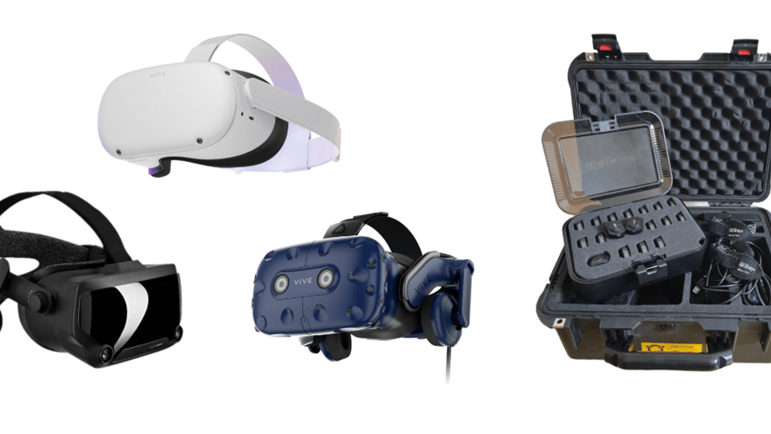
The key technology focus includes XR system integration, immersive simulation, and human-machine interaction. The testbed combines XR headsets, AR devices, high-performance computing units, and the Perception Neuron Studio motion capture system. The software stack includes Unity, Blender, and Python-based data analytics, supporting real-time rendering, 3D modelling, and behavioural data analysis.
HOSTING INSTITUTION AND PI INFO
| Name of Host Organization | XR Institute |
| Department or Lab | N.A. |
| Name of Building | TechTower |
| Physical Address | Koterovská 2827/152, 32600, Pilsen |
| Website Links | https://www.techtower.cz/en/ |
| Institutional contact name | Ing. Marek Bureš, Ph.D. |
| Institutional contact email | bures@xr-institute.cz |
APPLICATION CASES
| Application case: | Short description: |
| Digitalization of Rehabilitation Care in Children with motor disorders based on augmented reality |
The XR Institute’s ImmersiLab – Immersive Technology & Simulation Testbed has been utilized in diverse projects, experiments and innovation activities aligned with the objectives of the CITADELS project. One representative case is the project titled Digitalization of Rehabilitation Care in Children with motor disorders based on augmented reality (TQ01000031). In this project (running September 2023 – August 2026), XR Institute utilised its lab infrastructure to develop and test XR-based rehabilitation solutions for children aged 8-15 with central neuromuscular disorders. The testbed was used to create immersive training scenarios for fine and gross motor skills, postural control and balance training, and to validate these systems with rehabilitation professionals in real-world clinical settings. Through this use-case, the Virtual & Mixed Reality Lab serves as a Proof-of-Concept platform, allowing seconded talents within CITADELS to prototype XR applications, integrate motion capture and physiological sensors, and deploy interactive scenarios. The lab supports DeepTech Deployment by providing a controlled but realistic environment for multi-sensor experiments and user-centred interaction validation, thus strengthening the human-centric Industry 5.0 vision. Description of applications: Our VR rehabilitation testbed offers a portfolio of applications for fine motor skills training that are routinely used in clinical trials, thesis projects and PoC studies. Typical use cases include post-stroke and post-trauma patients training precision grasp and hand coordination through tasks such as virtual fruit picking, planting flowers, removing pegs from a clothesline or a VR “memory cubes” game, each with configurable difficulty and built-in performance metrics (time, number of items, error rate). These scenarios are ideal for DeepTech experiments on adaptive difficulty control, kinematic analysis of hand trajectories or AI-based feedback, as visiting researchers can access detailed performance logs and quickly prototype new control algorithms on top of existing tasks. For gross motor skills, the testbed includes applications such as fishing, pet stroking, uncovering pictures on a large table or tracing “magic” shapes with a wand, all designed to activate large ranges of motion in the shoulder, elbow and trunk while embedding the movements in playful, goal-oriented activities. These scenarios are used in PoC studies to evaluate patient engagement, movement quality and tolerance to higher loads, e.g. by varying task amplitude, speed and cognitive demands. Seconded experts can use the same environments to test novel sensor configurations (inertial, EMG), new gamification concepts or multimodal feedback strategies, while clinicians and students use them in routine therapy to standardise training and document progress. The walking modules of the testbed target gait rehabilitation and spatial orientation through immersive tasks such as crawling through a hollow tree trunk, crossing a stream via stepping stones or navigating hedge mazes and rock corridors. Each scenario records completion times and errors (e.g. contacts with obstacles, steps “into the water”), enabling controlled experiments on different gait strategies, assistive devices or cueing methods (visual vs verbal). These environments have already been used in proof-of-concept trials to test how VR-based variable terrain and constrained paths influence gait symmetry, step length and dynamic stability, and they provide seconded researchers with a safe, highly configurable “virtual obstacle course” without the need to reconfigure physical hardware. For balance and postural control, the testbed offers scenarios focused on dynamic stability and head-trunk coordination, such as harvesting fruit around a tree in progressively challenging stances, tracking moving balloons with whole-body rotation, dual-task “bimanual balloon tracking”, or visual guidance for exercises on unstable platforms like Posturomed. Outcome measures include time in stable stance, number of balance loose or tracking accuracy, making these modules suitable for DeepTech deployment of new balance assessment algorithms, biofeedback systems or wearable sensors. Beyond experimental work, the testbed is integrated into teaching in physiotherapy and occupational therapy programs and supports collaborative projects with SMEs developing rehabilitation technologies, providing a realistic, data-rich environment to evaluate and demonstrate novel solutions across the full spectrum of fine motor control, gross motor skills, gait and balance. |

POTENTIAL STAKEHOLDERS
Non-academic stakeholders
Industrial Partners, Startups, SMEs
Academic stakeholders
PhD students, MSc students, Researchers