



Autonomous Mobile Robot TurtleBot3 TestBed

SHORT SUMMARY
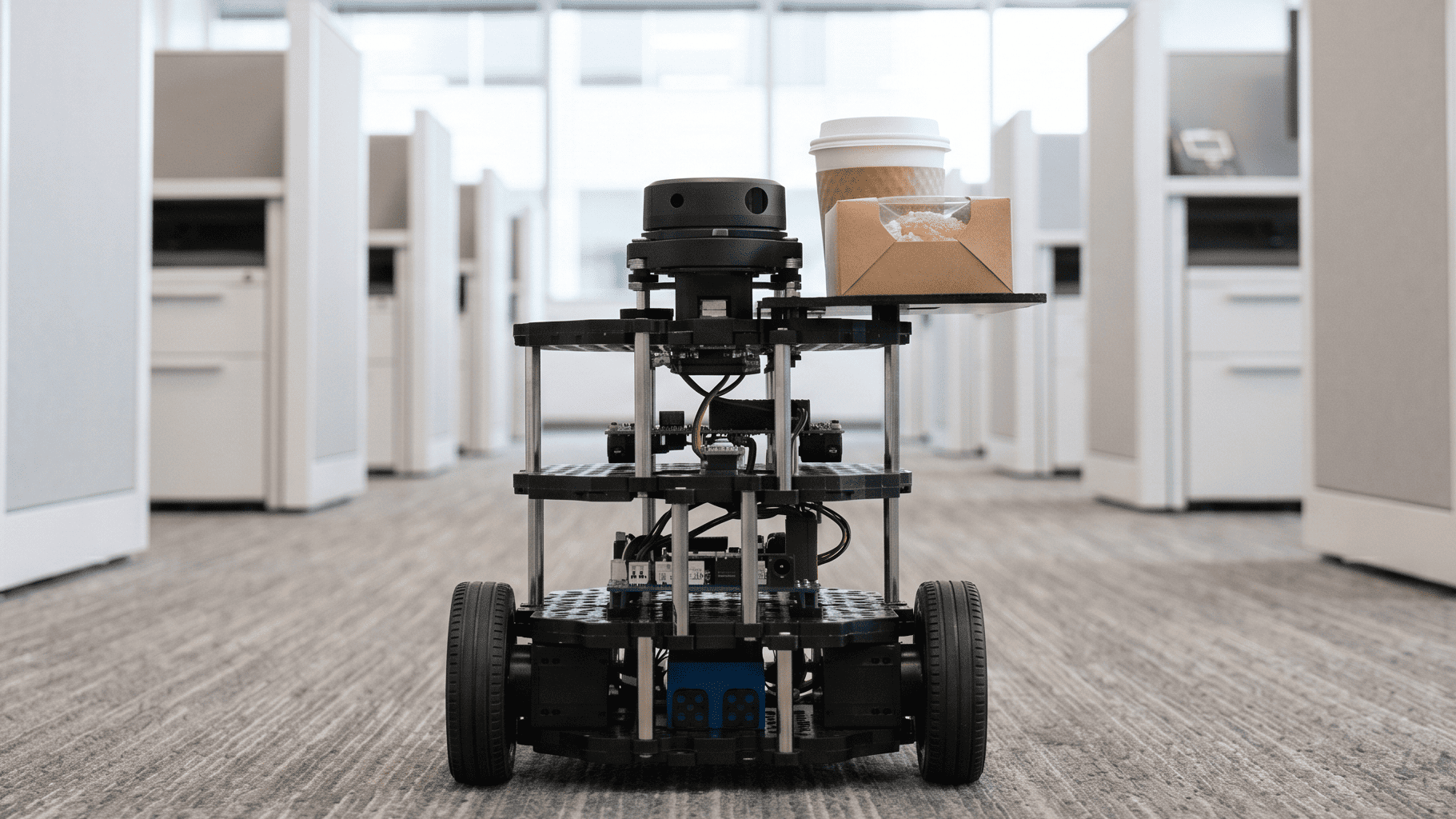
The AMR TestBed offers a ROS 2 (Humble)-based autonomous mobile robot platform built around the TurtleBot3 robotic system. It serves as an educational and research facility for students and researchers in autonomous navigation, sensor data processing, motion control, and human-robot interaction. The TestBed supports the University of Belgrade School of Electrical Engineering’s Autonomous Mobile Robots (AMR) course, providing hands-on experience with real-world robotic systems. Key technologies include ROS 2, Python-based robotics programming, LiDAR-based sensor processing, odometry integration, and kinematic control. The platform enables research spanning TRL 4–6, from component validation in lab environments to prototype demonstration in operational settings, contributing to DeepTech advancement in robotics education and collaborative robotics research.

HOSTING INSTITUTION AND PI INFO
| Name of Host Organization | University of Belgrade – School of Electrical Engineering (ETF) |
| Department or Lab | ETF Robotics Laboratory |
| Name of Building | School of Electrical Engineering |
| Physical Address | Bulevar kralja Aleksandra 73, 11120 Belgrade, Serbia |
| Website Links | https://www.etf.bg.ac.rs |
| Institutional contact name | Nikola Knezevic |
| Institutional contact email | knezevic@etf.rs |

APPLICATION CASES
| Application case: | Short description: |
| Autonomous driving of TurtleBot3 with Reinforcement Learning | Implementation of Q-learning algorithm and Feedback control for the mobile robot (turtlebot3_burger) in ROS. |
| Autonomous Exploration and Mapping Using Two Mobile Robots | Two “Turtlebot 3 Burger” robots were used. Turtlebots were equipped with LIDAR sensors and odometers, which enable simultaneous localization and mapping, for which the RBPF-SLAM algorithm based on a particle filter was used. Each robot forms its own local map that is represented by an occupancy grid. Then, map merging into a common global map is performed, based on known initial positions of the robots. |

POTENTIAL STAKEHOLDERS
Non-academic stakeholders
Industrial Partners, Startups, SMEs, Community
Academic stakeholders
Undergraduate students, PhD students, MSc students, Researchers