



LLM-TRAIN: Large Language Model Training and Fine-Tuning Environment

SHORT SUMMARY
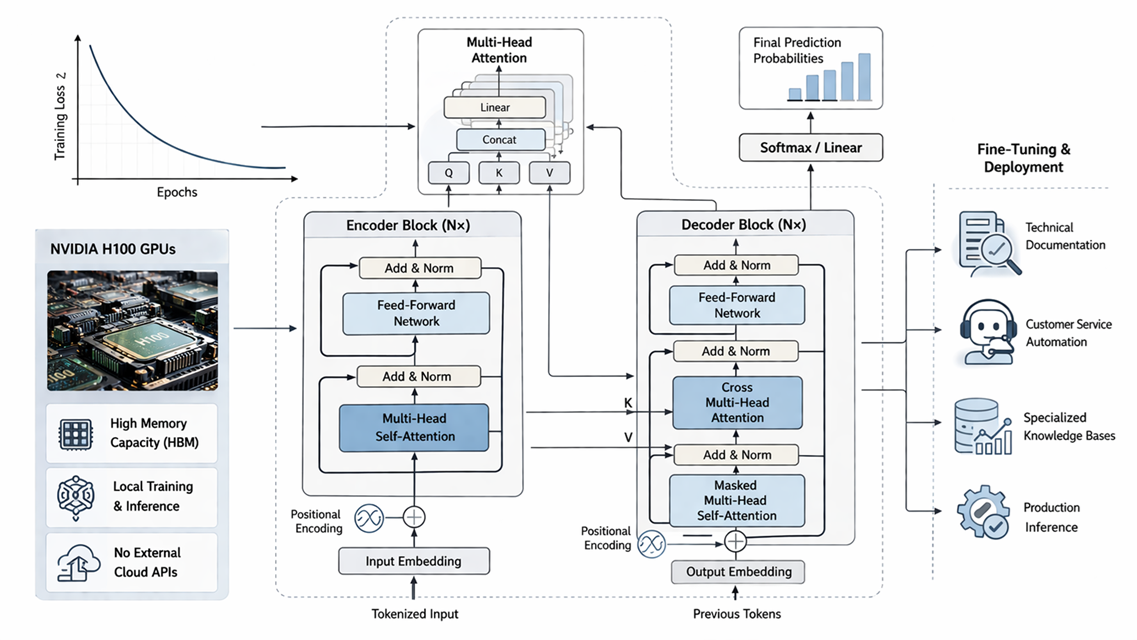
The LLM Training and Fine-Tuning Environment provides dedicated computational resources for developing, training, and deploying local large language models without relying on external cloud APIs. Built on NVIDIA H100 GPUs with extensive memory capacity, this testbed enables researchers and industry partners to customize open-source language models (Llama, Mistral, BERT variants) for domain-specific applications including technical documentation, customer service automation, and specialized knowledge bases. The environment supports the full LLM lifecycle from pre-training on custom corpora to fine-tuning with techniques like LoRA and QLoRA, and inference optimization for production deployment. This testbed contributes to the CITADELS Framework by democratizing access to state-of-the-art generative AI capabilities while maintaining data sovereignty and privacy.

HOSTING INSTITUTION AND PI INFO
| Name of Host Organization | NOVA Information Management School (NOVA IMS), Universidade Nova de Lisboa |
| Department or Lab | MagIC (Information Management Research Center) – the NOVA Information Management School research and development center |
| Name of Building | Manuel Vilares Building |
| Physical Address | Campus de Campolide, 1070-312 Lisboa |
| Website Links | https://www.novaims.unl.pt/ |
| Institutional contact name | Cristina Oliveira |
| Institutional contact email | magic@novaims.unl.pt |

APPLICATION CASES
| Application case: | Short description: |
| Fine tuning LLM | Fine-tune open-source multilingual models (e.g., BLOOM, Llama) on a curated corpus of Portuguese legal documents. |
| RAG Legal Document Retrieval | Implement RAG (Retrieval-Augmented Generation) to ensure accurate citation of legal precedents |
| Test / chat interfaces | Deploy custom chat interface for lawyers to query case law and generate legal briefs |

POTENTIAL STAKEHOLDERS
Non-academic stakeholders
Industrial Partners, Startups, Professional Associations, SMEs, Government Bodies, Other (Public agencies and municipalities)
Academic stakeholders
PhD students, MSc students, Researchers, Other (Visiting researchers, Seconded researchers)
Other types of stakeholders
R&I support professionals, R&I infrastructure operators, Innovation intermediaries, Technology transfer actors