



Collaborative Robotics Testbed
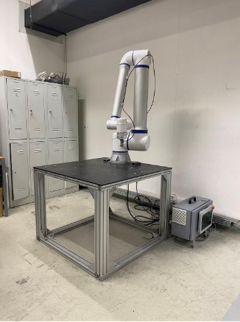

SHORT SUMMARY
The Collaborative Robotics Testbed provides an advanced human–robot collaboration (HRC) environment designed for hands-on training, experimentation, and Proof-of-Concept validation in industrial automation. Based on collaborative robotic platforms, the TestBed enables safe, flexible interaction between operators and robots in shared workspaces.
It supports applications such as collaborative assembly, intelligent sorting, AI-based perception, and neuroergonomic workstation integration.
The key technology focus lies in DeepTech domains including collaborative robotics, artificial intelligence, computer vision, and human-centered system design. The integration of advanced sensors, safety systems, and data-driven control frameworks allows experimentation across TRL 4–6, bridging academic research and industrial deployment.
The TestBed is highly relevant to Industry 5.0, promoting human-centric, safe, and sustainable manufacturing systems. It fosters co-creation between academia and industry, supports talent development in widening countries, and enables validation of responsible, AI-enabled automation solutions aligned with European Industry 5.0 priorities.

HOSTING INSTITUTION AND PI INFO
| Name of Host Organization | Industrial Automation d.o.o Tuzla |
| Department or Lab | Industrial Hub |
| Name of Building | Sports-Cultural-Economic Center (SKPC) Mejdan |
| Physical Address | Bosne Srebrene bb, 75000 Tuzla, Bosnia and Herzegovina |
| Website Links |
https://www.dkr.ba/
https://industrialhub.ba/testbeds/collaborative-robotics-testbed/ |
| Institutional contact name | Ahmed Korlatović |
| Institutional contact email | a.korlatovic@dkr.ba |

APPLICATION CASES
| Application case: | Short description: |
| Human–Robot Collaborative Assembly | The cobot cell supports shared assembly tasks where the robot handles positioning, screwing, or component transfer, while the operator performs fine manipulation. The TestBed enables validation of safe interaction modes, cycle time optimization, and ergonomic assessment before deployment in SME production lines. |
| AI-Based Vision Sorting | The TestBed integrates AI-driven vision systems for object detection, classification, and robotic sorting. It is used to validate perception algorithms in semi-structured industrial environments, supporting Proof-of-Concept development for smart manufacturing and circular-economy applications. |
| Neuroergonomic Workstation Optimization | The cobot cell is used to evaluate human workload and adapt robotic assistance accordingly. By combining motion tracking and operator monitoring, the TestBed enables development of human-centric automation solutions aligned with Industry 5.0 principles. |
| SME Automation Feasibility Pilot | The TestBed serves as a pre-deployment validation environment for SMEs considering collaborative robotics. Companies can simulate real production tasks, measure performance indicators, and assess return-on-investment before investing in full-scale automation. |
| Adaptive Impedance Control for Safe Interaction | The platform allows experimentation with task-specific stiffness shaping and compliant motion control. This supports validation of safe contact-based operations such as insertion, polishing, or precision handling in collaborative environments. |

POTENTIAL STAKEHOLDERS
| Non-academic stakeholders | |
| Industrial Partners | |
| Startups | |
| Professional Associations | |
| SMEs | |
| Government Bodies | |
| Community | |
| Other | |
| Academic stakeholders | |
| Undergraduate students | |
| PhD students | |
| MSc students | |
| Researchers | |
| Other | |
| Other types of stakeholders | |
| Other | |

LINKS TO MORE INFO
TODO Some link………